
BRAC CIN: Counter Interaction Risk Monitoring
Pose-based monitoring of potentially unsafe counter interactions using customer and banker regions, counter-line geometry, role stabilization, temporal voting, evidence capture, and optional local vision-language review.
Module of BRAC CIN; presented as a separate case study.
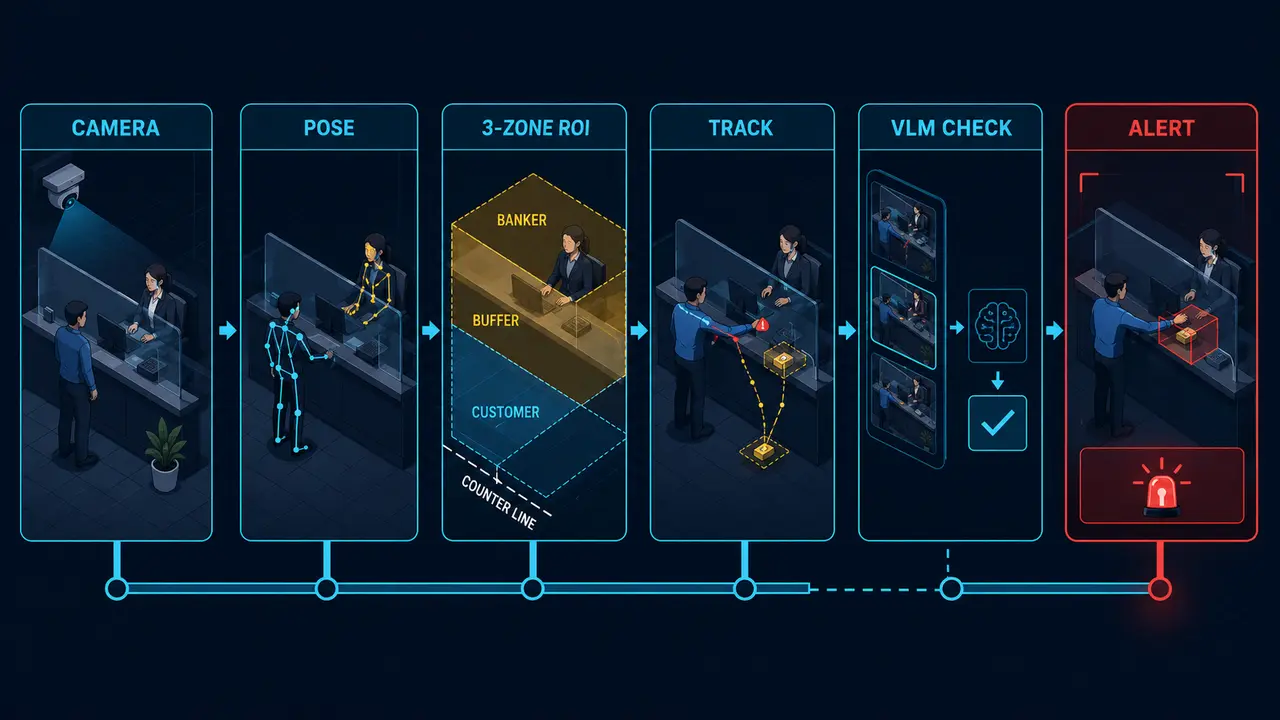
Workflow at a glance
Estimate pose
Locate people and body keypoints.
Check counter regions
Evaluate customer/banker geometry and roles.
Consolidate events
Vote over time; optional VLM event review.
Human assessment
Deliver evidence as a risk signal, not proof.
Project facts & reported results
Implementation fact
Implementation fact
Implementation fact
Project Overview
Problem Statement
Suspicious counter interactions are defined by body pose, role, location, and movement across a transaction boundary—not by the presence of a single object.
Approach & Methodology
Combined YOLO11 Pose keypoints with customer and banker regions and counter-line geometry. Role stabilization and temporal voting consolidate observations; optional local vision-language review provides an additional event check before evidence delivery.
Outcome & Scope
Implements spatial and temporal reasoning for reviewable theft-risk events while keeping API delivery independent from inference.
System Architecture
Spatial and temporal event screening with optional secondary model review.
Key Components:
Locate people and body keypoints.
Evaluate keypoints relative to configured regions and the counter line.
Consolidate event candidates across observations.
Store snapshots and deliver flagged events; optional VLM review can provide a secondary signal.
Key Features & Capabilities
Customer and banker regions with counter-line geometry
Pose-based counter-interaction signals
Role stabilization and temporal confirmation
Optional local vision-language event review
Snapshots and retryable event delivery for human assessment
Current Scope & Limitations
A flagged interaction is a risk signal for human review, not proof of theft or intent.
Pose visibility, camera geometry, and secondary model errors can affect alerts.