
BRAC CIN: Lying-Person & Unusual Activity Monitoring
Detects lying or fallen persons and policy-defined unusual activity using YOLO11 Pose, geometry scoring, track history, weighted temporal voting, cooldowns, and evidence deduplication.
Module of BRAC CIN; presented as a separate case study.
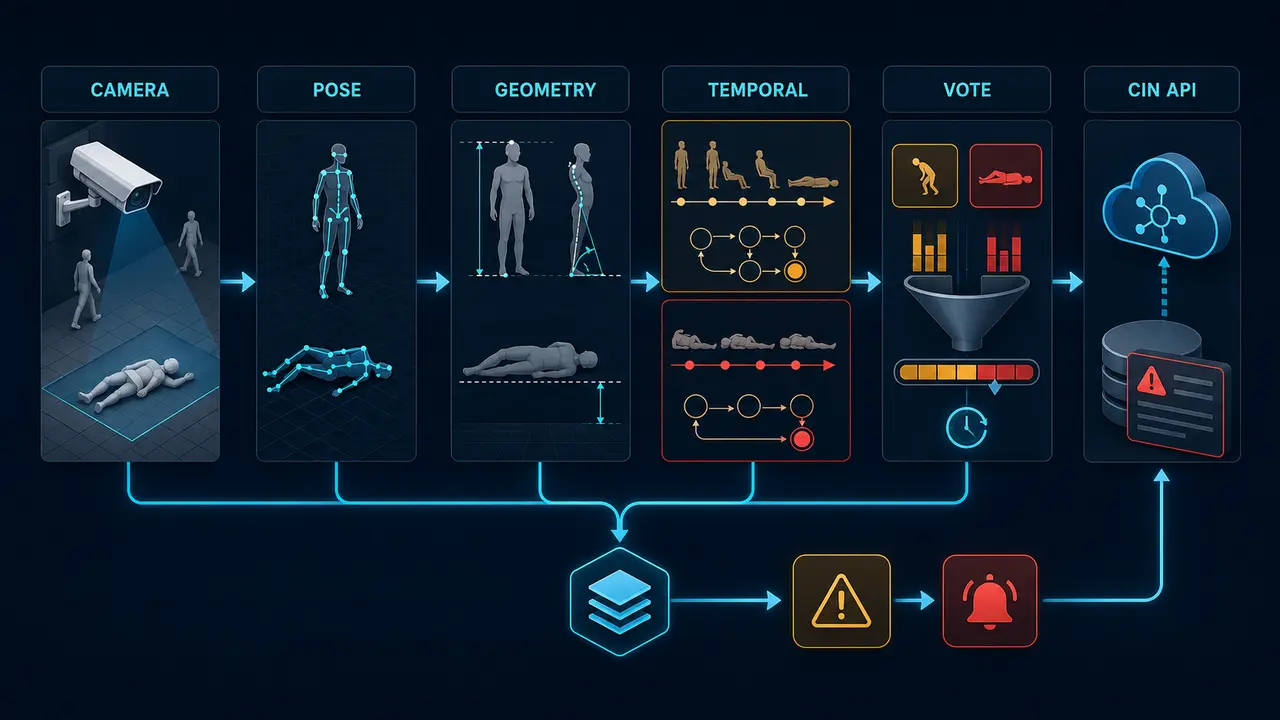
Workflow at a glance
Detect people
Observe pose and person tracks.
Evaluate activity
Assess geometry and configured activity cues.
Consolidate signals
Apply temporal voting and cooldowns.
Review evidence
Deliver deduplicated event snapshots.
Project facts & reported results
Implementation fact
Implementation fact
Implementation fact
Project Overview
Problem Statement
Stationary emergencies and prolonged booth misuse are difficult to capture with motion detection and require posture, duration, and track-level context.
Approach & Methodology
Implemented human pose keypoint analysis using YOLO11 Pose to compute body aspect ratios, spine angles, and ground-proximity ratios. Built temporal posture classification to differentiate brief kneeling from prolonged lying/collapse, and integrated loitering dwell time logic.
Outcome & Scope
Produces evidence-backed events for security review while applying separate temporal policies for posture and dwell-time scenarios.
System Architecture
Pose keypoint surveillance engine with temporal posture state machine
Key Components:
Extracts 17 human body keypoints per frame
Calculates spine inclination angle and torso-to-ground distance
Tracks posture duration to prevent false alerts from bending or picking up dropped items
Dispatches high-priority event notifications with image snapshots
Key Features & Capabilities
Pose keypoint analysis for body orientation and ground proximity detection
Distinguishes between normal customer transactions and collapsed/lying individuals
Loitering detection with configurable dwell time thresholds
Headless background processing with optional multicam grid viewer
Automated API dispatch with evidence snapshot storage