

CV Agent Ecosystem: Multi-Agent Computer Vision Delivery
A LangGraph-based engineering prototype that organizes computer-vision briefs into plans and project scaffolds through specialist agents, human approval gates, and reusable templates.
Internal R&D / Personal Engineering Project at Bondstein Technologies Ltd.
Work dates not published
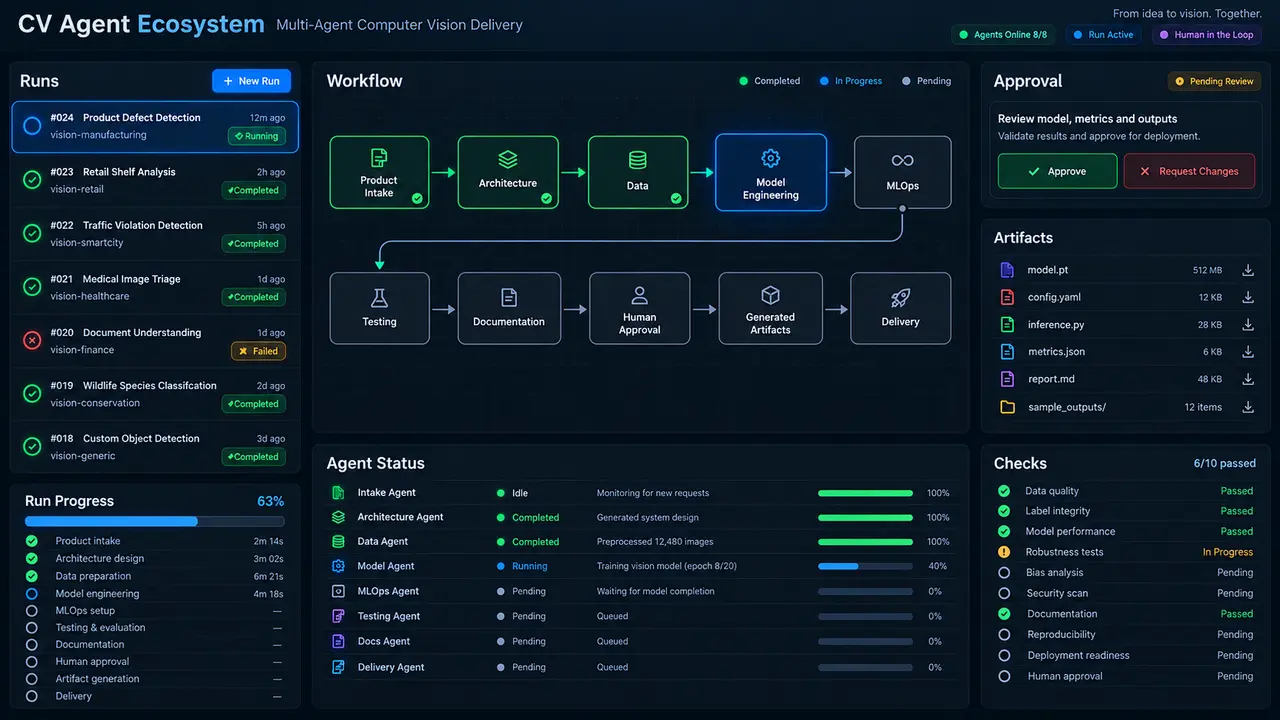
Workflow at a glance
Define a CV brief
Capture project requirements and constraints.
Plan with agents
Organize specialist engineering phases.
Human approval
Gate transitions and review proposed work.
Generate scaffolds
Create artifacts for separate validation.
Project Overview
Problem Statement
Repeating the same discovery, data, architecture, code, MLOps, review, and documentation work for every computer-vision project creates inconsistency and makes risky automation difficult to control.
Approach & Methodology
Implemented a typed shared-state graph with specialist phases for product intake, architecture, data, MLOps, code generation, optimization, review, testing, documentation, and operations. Human sign-offs gate phase transitions, while template generation and optional quality checks remain separate from training or deployment actions.
Outcome & Scope
Created an internal prototype that standardizes the path from problem brief to an auditable computer-vision project scaffold while keeping expensive or destructive steps human-controlled.
Engineering Contribution
Engineering contribution focused on the typed orchestration graph, specialist agent contracts, human approval boundaries, project templates, retrieval layer, guarded execution, and run-inspection API; generated downstream systems still require independent validation.
Technical Challenges & Solutions
Coordinating specialist agents
Architecture, data, model, operations, review, and documentation phases need a shared contract instead of loosely connected prompts.
Used a typed project state and explicit graph transitions to make phase ownership, inputs, outputs, and review loops visible.
Bounding automation risk
Generating files is materially safer than starting training jobs or deploying infrastructure automatically.
Separated execution gates by action, kept training and deployment disabled by default, and inserted human approval before sensitive transitions.
Reusing engineering knowledge
Useful patterns are distributed across templates and earlier codebases but should be referenced without modifying source repositories.
Combined template generation with optional read-only pattern indexing and retrieval.
Keeping outputs auditable
A multi-step system needs inspectable artifacts and review state at each phase.
Persisted structured phase outputs, reviews, approvals, run status, generated files, and operational documentation.
System Architecture
A human-gated LangGraph workflow that coordinates specialist engineering roles around typed project state and guarded artifact generation.
Key Components:
Structures the computer-vision brief, constraints, risks, and acceptance criteria.
Coordinates architecture, data, MLOps, implementation, optimization, testing, review, documentation, and operations phases.
Pauses sensitive phase transitions for review, revision, or escalation.
Retrieves reusable patterns and generates consistent project, service, CI, and operations artifacts.
Exposes run state, configuration, generated files, and knowledge lookup for inspection.
Key Features & Capabilities
Typed multi-agent workflow with specialist engineering phases
Human approval gates, revision loops, and an explicit escalation path
Template-driven training, inference, export, service, CI, and operations scaffolding
Optional code-pattern retrieval from indexed, read-only repositories
Atomic artifact writing with gated quality and synthetic benchmark hooks
Dashboard and API for runs, generated files, configuration, and knowledge lookup
Training, deployment, and live monitoring remain disabled by default
Current Scope & Limitations
Generated projects still require real datasets, GPU testing, and environment-specific deployment validation.
Model-routing privacy depends on external configuration and is not a hard network isolation boundary.
Credential handling and API access controls require hardening before broader use.
The supplied source package was inspected but not executed.
Technologies & Tools
Optional integrations
- ChromaDB
Generated scaffold integrations
- DVC
- ZenML
- Kubernetes
- Prometheus