

HR Assist: Agentic HR Service Desk
Internal HR service-desk implementation combining cited policy answers, role-based self-service, approval workflows, SLA tracking, email operations, and audit logs.
Internal R&D / Personal Engineering Project at Bondstein Technologies Ltd.
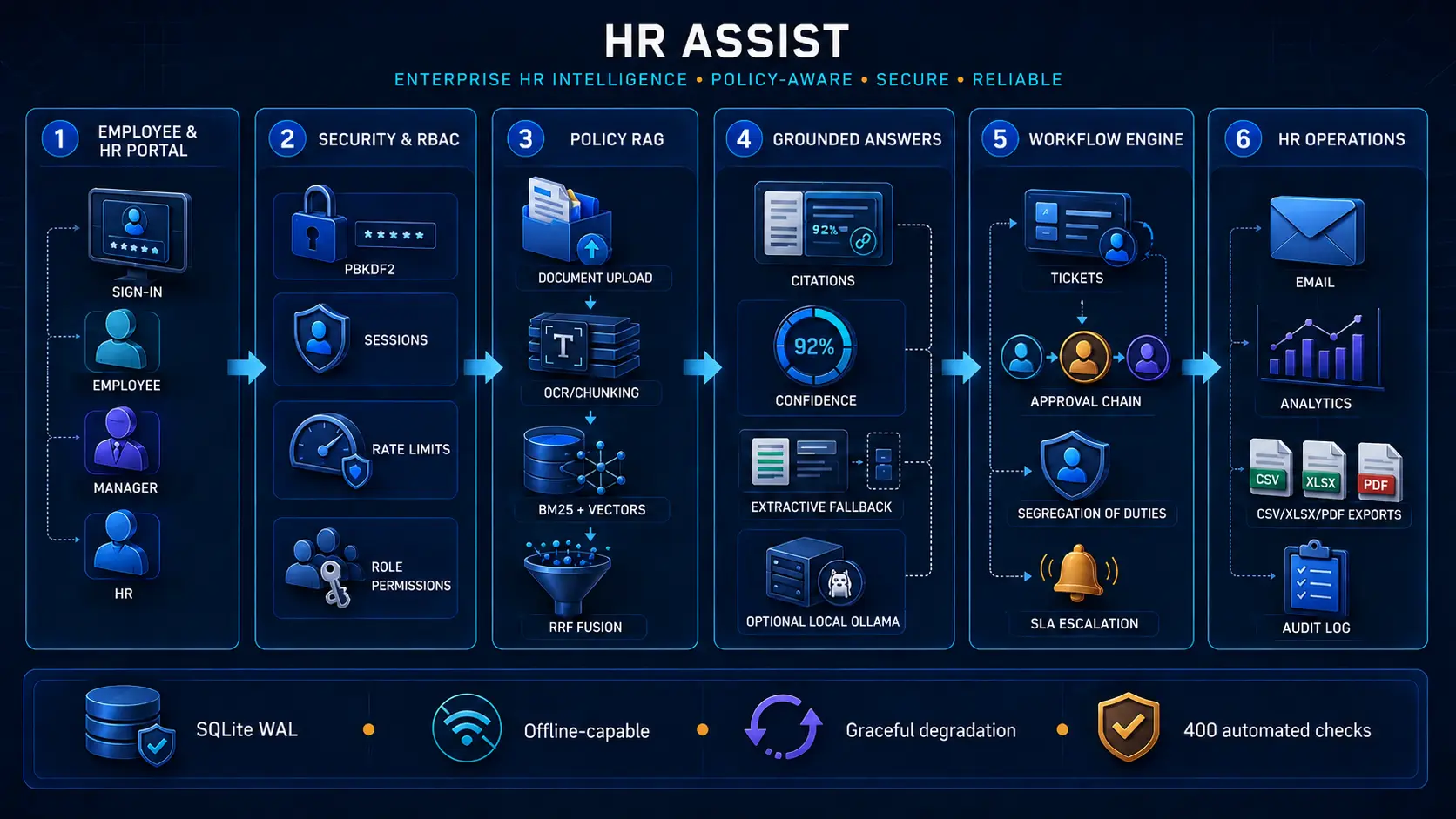
Workflow at a glance
Request with role context
Accept policy questions and HR requests.
Retrieve policy evidence
Use BM25 and optional vector retrieval.
Answer or route work
Return citations or enter approval workflows.
Track and audit
Record workflow events, SLA state, and history.
Project facts & reported results
Implementation fact
Implementation fact
Implementation fact
Project Overview
Problem Statement
Employees needed one reliable place to understand HR policy, submit requests, and see where approvals were blocked. HR also needed consistent access control, policy versioning, operational reporting, and an auditable workflow without depending on external cloud services.
Approach & Methodology
Built a FastAPI service with server-side sessions, role-based permissions, rate limiting, and segregation-of-duties controls. Policy documents are extracted, cleaned, chunked, and retrieved through BM25 plus optional sentence-transformer vectors fused with Reciprocal Rank Fusion. Answers use retrieved citations and fall back to extractive responses when a local Ollama model, vector extension, OCR, or SMTP is unavailable. A data-driven workflow engine resolves manager, department-head, queue, role, and named-user approval steps while tracking SLA deadlines and escalation.
Outcome & Scope
Implemented a single-host HR service desk with policy administration, tickets and approvals, email workflows, reporting, audit logs, and database migrations. API, role, and browser test code is included; a passing-check total is not independently verified.
System Architecture
Secure employee self-service, grounded policy intelligence, and auditable HR workflow orchestration on a single-host deployment.
Key Components:
Role-aware interface for policy chat, requests, approvals, mail, administration, and reporting.
PBKDF2 credentials, server-side sessions, lockout, rate limiting, provisioned signup, and permission enforcement.
PDF/DOCX extraction, OCR fallback, structured chunking, BM25, optional vectors, and RRF fusion with department scoping.
Cited responses with computed confidence, safe no-answer behavior, extractive fallback, and optional local Ollama synthesis.
Table-driven approval chains, resolver logic, self-approval prevention, ticket events, notifications, and SLA escalation.
Policy versions, threaded email, analytics, exports, audit logs, SQLite WAL, additive migrations, and system health reporting.
Key Features & Capabilities
Policy-grounded HR answers with clause-level citations and computed confidence
BM25 and optional vector retrieval combined through Reciprocal Rank Fusion
Extractive fallback with optional local Ollama synthesis and local answer retrieval; mail delivery requires connectivity
Employee provisioning, secure sign-up, PBKDF2 password hashing, session expiry, lockout, and rate limits
Server-enforced Employee, Manager, HR Admin, CEO, and System Owner permissions
Data-driven multi-step approvals with manager, department, queue, role, and user resolvers
Segregation of duties that checks for self-approval
Priority-based SLA clocks, breach flags, notifications, and automatic escalation
Threaded HR email, policy versioning, aggregate analytics, and CSV/XLSX/PDF exports
SQLite schema migrations, WAL concurrency, audit logs, health status, and graceful degradation
Current Scope & Limitations
The supplied implementation and tests were source-inspected, not independently executed in this portfolio review.
Local retrieval and optional local synthesis can operate without a hosted model; mail and external integrations need connectivity.
Retrieval confidence is a ranking signal, not a calibrated probability that an answer is correct.
Technologies & Tools
Optional integrations
- Sentence Transformers
- sqlite-vec
- Ollama