
Transfer Learning for Mental Stability Classification
Comparative research on VGG16, InceptionV3, and DenseNet121 for voice-spectrogram classification using augmentation and transfer learning.
Preprint · 2026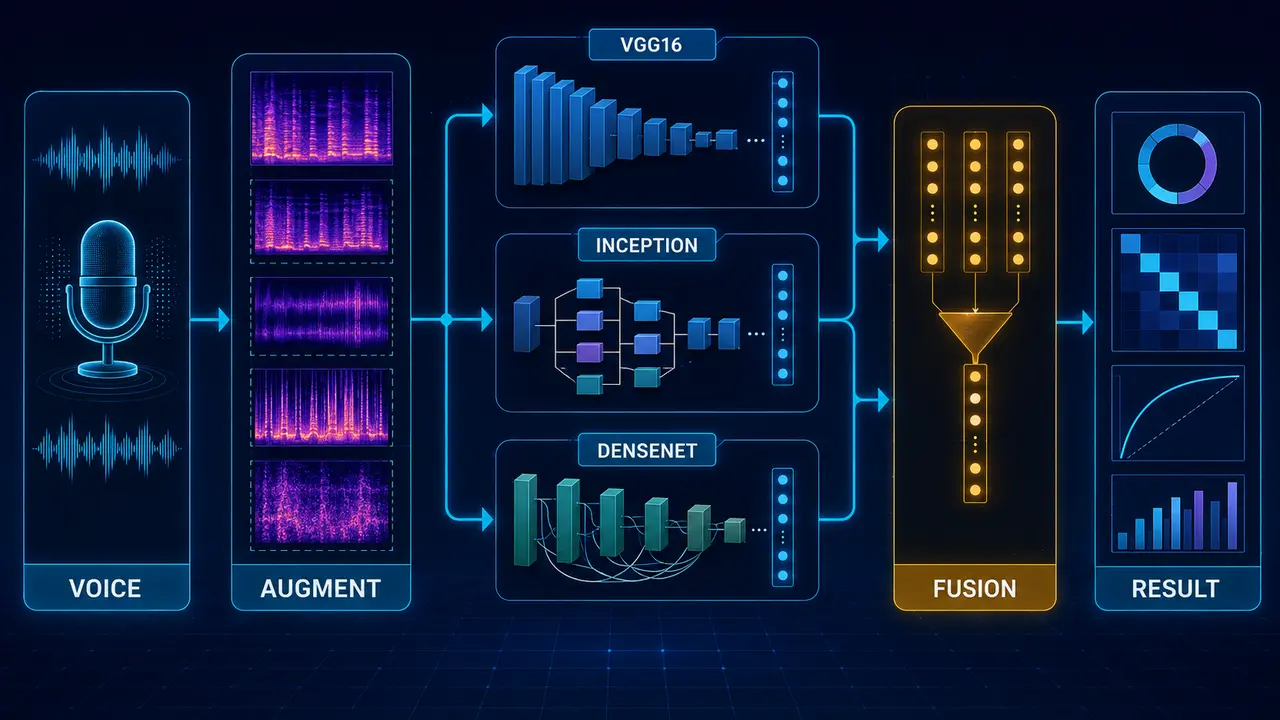
Workflow at a glance
Prepare spectrograms
Represent voice recordings as image inputs.
Define training regimes
Compare augmentation and transfer learning.
Compare three models
Evaluate VGG16, InceptionV3, and DenseNet121.
Report study results
Compare separate models; no ensemble fusion.
Project facts & reported results
Reported result
Reported study result; see linked paper for evaluation protocol.
Reported result
Reported study result; see linked paper for evaluation protocol.
Implementation fact
Project Overview
Problem Statement
Limited voice data makes it difficult to compare model architectures and distinguish learned patterns from overfitting. This study evaluates augmentation and transfer learning under that constraint.
Approach & Methodology
Compared VGG16, InceptionV3, and DenseNet121 across non-augmented, augmented, and transfer-learning experiments. The paper describes pre-training on augmented data and fine-tuning on non-augmented data with strict data separation.
Outcome & Scope
The preprint reports DenseNet121 as the strongest of the three compared models, with 94% accuracy and 0.99 AUC. These are study results, not evidence of clinical readiness.
System Architecture
Independent architecture comparisons across training regimes; no ensemble fusion is claimed.
Key Components:
Represent voice recordings as spectrogram inputs.
Compare non-augmented, augmented, and transfer-learning experiments.
Train and evaluate VGG16, InceptionV3, and DenseNet121 separately.
Compare accuracy and ROC-AUC under the study protocol.
Key Features & Capabilities
Voice-to-spectrogram conversion with STFT
Transfer learning with multiple CNN architectures
Data augmentation for improved robustness
Binary classification (stable vs. unstable)
Training/validation visualization (accuracy, loss, confusion matrix, ROC curves)
Comparative analysis of VGG16, InceptionV3, and DenseNet121
Current Scope & Limitations
Research use only. These experiments do not establish a clinically validated diagnostic or screening tool.
Reported scores apply to the study protocol. Split definitions and evaluation details should be checked in the linked paper before comparing results across studies.