
Skin Cancer Detection Using Computer Vision
Research on benign/malignant skin-lesion classification using HAM10000 and a custom DCNN, with saliency and attention visualizations. Presented as an arXiv preprint.
Preprint · 2025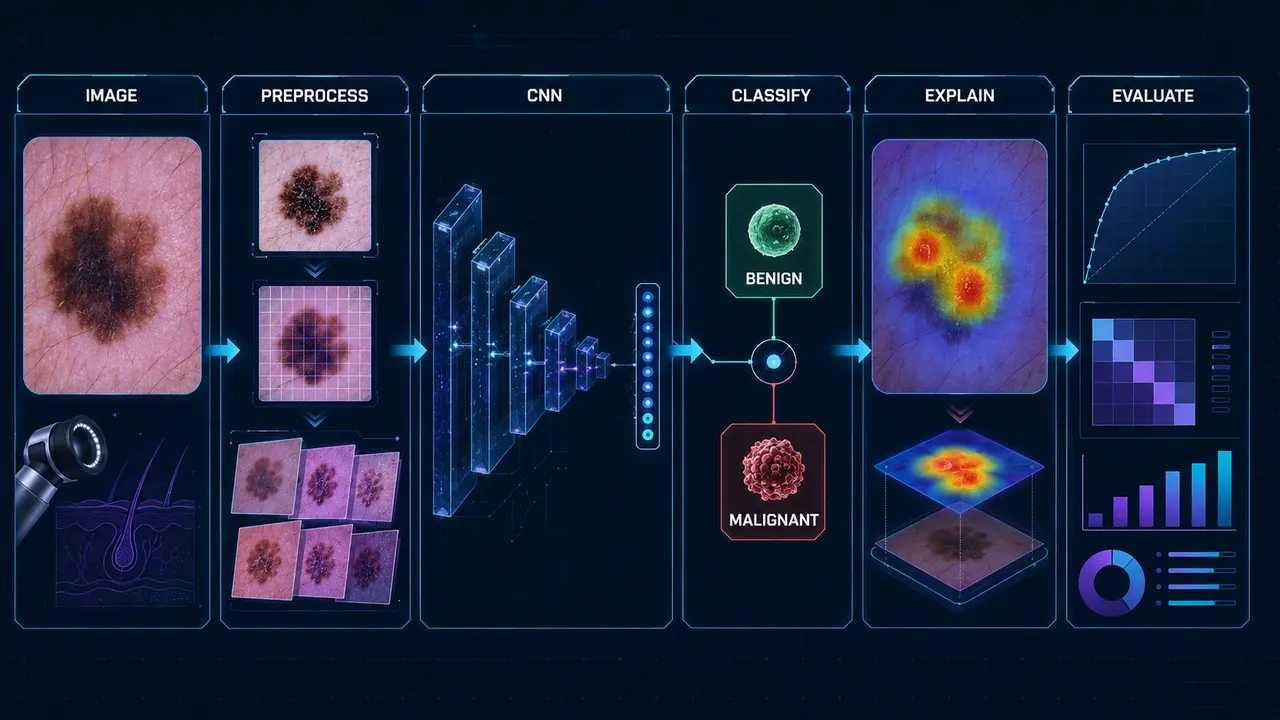
Workflow at a glance
Prepare lesion images
Use HAM10000 research imagery.
Train and compare
Study a custom DCNN and baseline models.
Explain predictions
Inspect saliency and attention visualizations.
Evaluate study results
Report research metrics, not clinical readiness.
Project facts & reported results
Reported result
Reported study result; see linked paper for evaluation protocol.
Implementation fact
Implementation fact
Implementation fact
Project Overview
Problem Statement
Skin-lesion classification requires careful evaluation and interpretable results. This study explores image-based research methods using HAM10000; local clinical applicability is not established.
Approach & Methodology
Developed custom DCNN architecture trained on HAM10000 dataset (10,000+ dermoscopy images). Implemented preprocessing pipeline with noise removal, normalization, and data augmentation (rotation, flipping, color shifts). Used transfer learning from InceptionV3. Added saliency maps, Grad-CAM, and attention visualization for interpretability and transparent decision support. Included comparative analysis across transfer learning models plus a computationally efficient model approach.
Outcome & Scope
Achieved 93.16% testing accuracy outperforming DenseNet (90.31%) and MobileNet (88.26%). Published paper demonstrating practical application for Bangladesh healthcare context. Model provides explainable predictions through attention maps. Reduced execution time compared to existing models.
Key Features & Capabilities
Binary classification (benign/malignant)
Data preprocessing with augmentation
Transfer learning from InceptionV3
Saliency map visualization
ROC curve and confusion matrix analysis
Comparative model evaluation
Current Scope & Limitations
Research use only. These experiments do not establish a clinically validated diagnostic or screening tool.
Reported scores apply to the study protocol. Split definitions and evaluation details should be checked in the linked paper before comparing results across studies.