
Smart Dining Caloric Display System
Machine learning-based caloric estimation system for traditional Bangladeshi dishes to promote nutritional awareness.
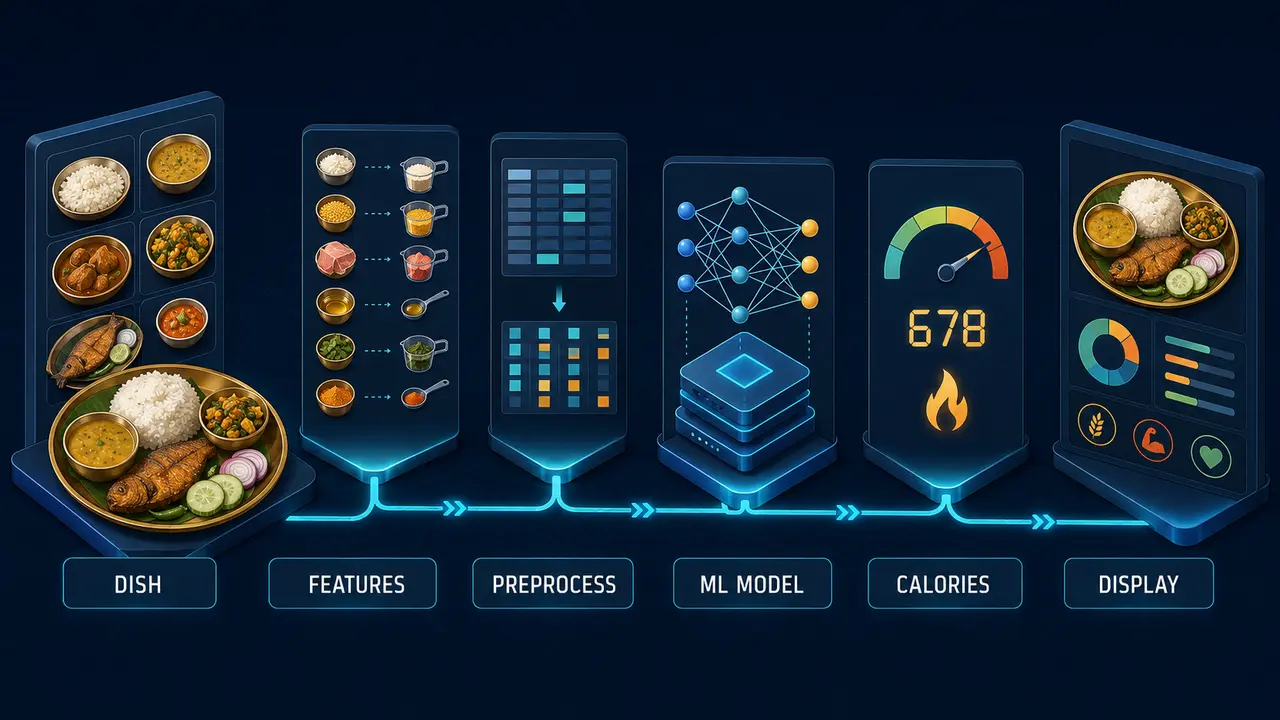
Workflow at a glance
Prepare food features
Represent dishes using available attributes.
Train regression models
Fit calorie-estimation models.
Compare predictions
Evaluate estimates against dataset targets.
Review estimates
Present research estimates with limitations.
Project facts & reported results
Reported result
Historical project result; evaluation not independently reproduced.
Reported result
Historical project result; evaluation not independently reproduced.
Implementation fact
Project Overview
Problem Statement
Diet-related health issues prevalent in Bangladesh but traditional dishes lack nutritional information. Restaurant menus don't provide caloric content. Need for automated system to estimate calories for informed dietary choices.
Approach & Methodology
Compiled dataset of Bangladeshi recipes with ingredient quantities from Food Composition Table for Bangladesh (2022). Trained multiple regression models: Linear Regression, Decision Tree, and Random Forest. Implemented ingredient-based feature extraction and recipe caloric calculation pipeline.
Outcome & Scope
Random Forest achieved best performance with 99.99% R² and MSE of 15.75 on test set. System enables real-time caloric prediction for restaurant menus. Academic project demonstrating ML application to local nutritional challenges. Promotes healthier eating through data-driven insights.
Key Features & Capabilities
Recipe ingredient parsing
Multi-model evaluation (LR, DT, RF)
Real-time caloric prediction API
Bangladeshi cuisine database
Model performance comparison
Feature importance analysis
Current Scope & Limitations
Historical course-project results are not independently reproduced here. Held-out split details, preprocessing boundaries, and metric units are not documented in this case study.