
Argus Automata: Industrial Safety Video Analytics
Multi-module safety platform covering vehicle overspeed estimation, PPE compliance, forklift-worker collision risk, restricted-area intrusion, unsafe behavior, and perimeter throwing detection.
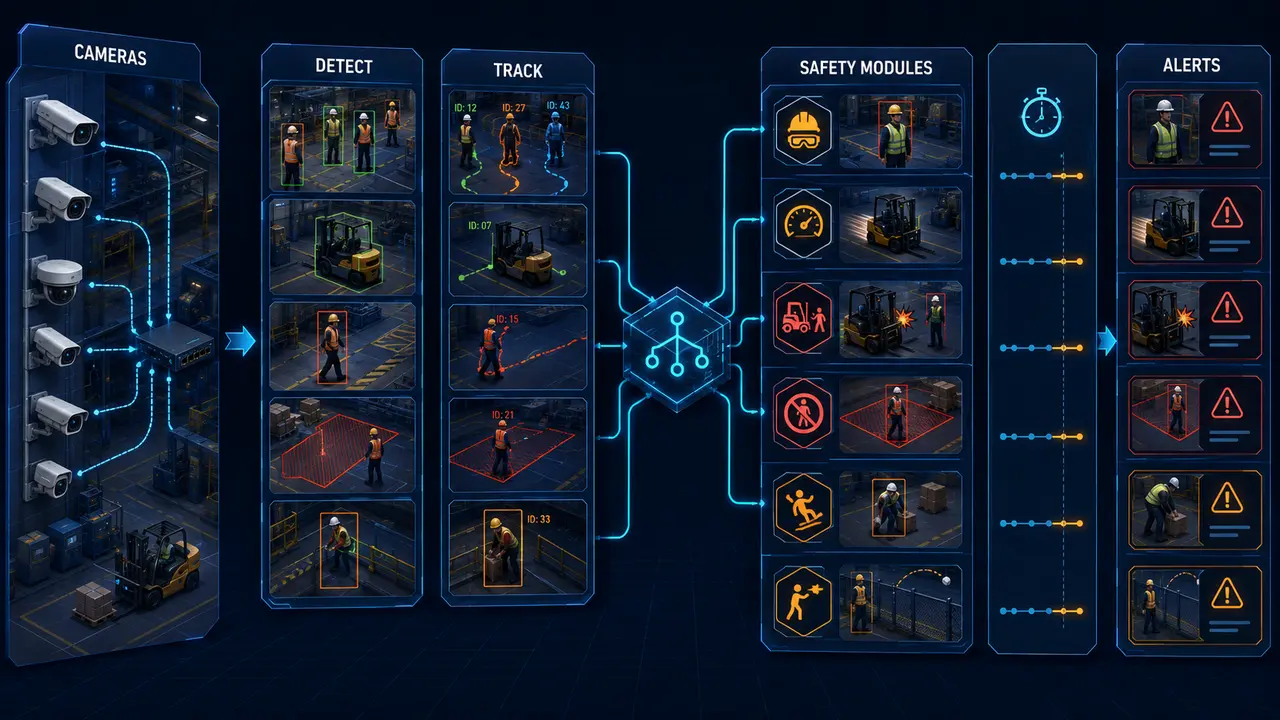
Workflow at a glance
Read video
Process camera frames for safety monitoring.
Detect and track
Track people and vehicles in configured regions.
Evaluate rules
Apply safety rules and temporal confirmation.
Review evidence
Queue evidence and deliver reviewable alerts.
Project facts & reported results
Implementation fact
Implementation fact
Implementation fact
Project Overview
Problem Statement
Safety teams need consistent monitoring across live factory cameras, while raw detector outputs create false alerts unless spatial and temporal context is applied.
Approach & Methodology
Built modular video analytics for overspeed estimation, PPE checks, proximity risk, restricted regions, and unsafe behavior. Detection and tracking feed camera-calibrated geometry and temporal rules; evidence is persisted and sent independently of inference.
Outcome & Scope
Converted multiple safety policies into config-driven video-analytics modules with ROI gating, tracking, temporal confirmation, evidence capture, local persistence, and API delivery.
Technical Challenges & Solutions
Perspective-sensitive speed estimates
Pixel displacement does not directly represent ground-plane distance.
Use camera-specific homography calibration and temporal smoothing.
Repeated and unstable detections
Single-frame detections can cause repeated or transient alerts.
Combine region gating, temporal confirmation, cooldowns, and evidence deduplication.
Inference and delivery failures
Video processing and external event delivery have different failure modes.
Separate inference from persistent evidence queues and retryable senders.
System Architecture
Detection, scene geometry, temporal decisions, and evidence delivery.
Key Components:
Acquire frames from configured monitoring views.
Associate people and vehicles across frames.
Evaluate calibrated speed, PPE, proximity, and region-based rules.
Persist event evidence and send it independently of inference.
Key Features & Capabilities
Camera-calibrated vehicle speed estimation
Helmet and vest monitoring
Forklift–person proximity risk signals
Restricted-region and unsafe-behavior event checks
Perimeter throwing-event cues
Evidence queues, cooldowns, and retryable delivery
Current Scope & Limitations
Camera calibration, object visibility, and scene changes affect results. Risk alerts support operator review; they do not guarantee accident prevention.
No cross-camera identity tracking, measured alert reduction, or operational camera count is claimed in this case study.