
VisionGuard: On-Prem Video Intelligence Platform
An on-premises video-intelligence R&D platform connecting camera monitoring, configurable ML tasks, spatial event rules, recordings, and operational health.
Internal R&D / Personal Engineering Project at Bondstein Technologies Ltd.
Work dates not published
Workflow at a glance
Configure monitoring
Set up cameras, tasks, and operator access.
Schedule inference
Supervise streams and local model workers.
Evaluate event rules
Apply spatial and temporal event rules.
Observe and review
Inspect evidence, recordings, and health.
Project Overview
Problem Statement
Video operations teams need one dependable control plane for live cameras, local inference, evidence, alerts, and system health without making a cloud-first service the center of the surveillance workflow.
Approach & Methodology
Designed a modular edge/server architecture around a typed API, supervised camera streams, bounded latest-frame inference, pluggable Python workers, a canonical task registry, ROI-aware detections, event rules, local persistence, and an operator interface. The implementation includes credential protection, network destination policies, worker recovery, recording controls, model validation, and health instrumentation.
Outcome & Scope
Produced a cohesive internal R&D platform whose core monitoring, ML orchestration, evidence, and operational controls are implemented at source level, with hardware-specific release validation still required.
Engineering Contribution
Engineering contribution covered the platform architecture, camera and worker orchestration, configurable vision-task integration, spatial event workflows, operational safeguards, and the monitoring interface; production adoption and deployment scale are not claimed.
Technical Challenges & Solutions
Preventing stale-frame buildup
Multiple live cameras can create more work than local inference workers can process in real time.
Used bounded latest-frame scheduling so stale work is discarded and inference stays focused on current scene state.
Containing stream and worker failures
A failed camera, model worker, or overloaded GPU should not collapse the wider monitoring service.
Added supervised stream and worker lifecycles with health tracking, retry backoff, circuit breakers, and guarded recovery paths.
Protecting video infrastructure
Camera credentials, network destinations, browser origins, and model downloads all cross security boundaries.
Implemented role-aware access, credential encryption and redaction, destination validation, origin checks, signed webhook support, and model checksum and format validation.
Reporting honest task availability
A configured vision task is not actually available unless its worker, dependencies, and model artifact are ready.
Centralized task definitions in a capability registry and gated assignment and health reporting against runtime readiness.
System Architecture
A local video-intelligence control plane that separates camera supervision, bounded inference, event decisions, evidence handling, and operational health.
Key Components:
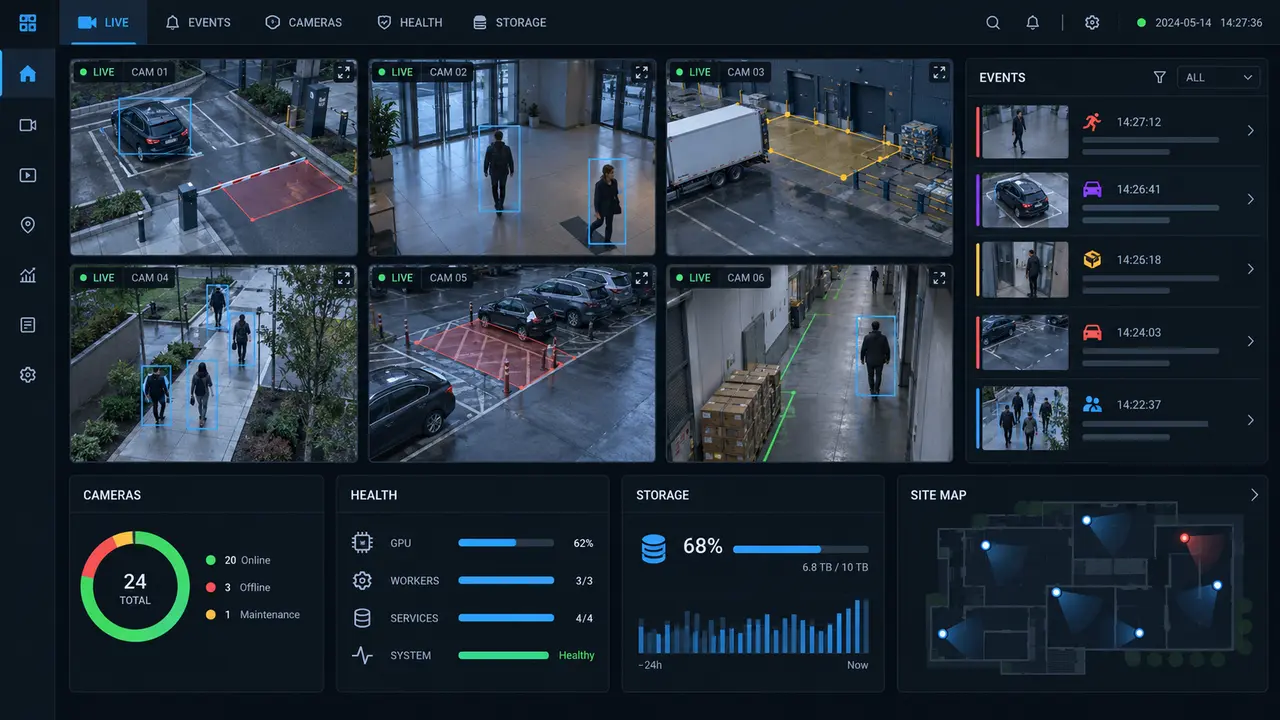
Authenticated live monitoring, camera setup, rule management, search, analytics, and operational status.
Manages stream lifecycles, segmented recording, retention, quota protection, and failure recovery.
Schedules current frames across task-specific workers and reports model and dependency readiness.
Applies regions, temporal predicates, deduplication, and evidence policies to detections.
Persists configuration and history while exposing health, metrics, storage, host, and worker telemetry.
Key Features & Capabilities
Authenticated camera monitoring with role-based administration
Canonical ML task registry with per-camera capability and dependency checks
ROI-aware detections, temporal event rules, alert deduplication, and evidence history
Bounded latest-frame scheduling with worker restart, backoff, and circuit-breaker controls
Recording, retention, search, analytics, notifications, and bounded webhook delivery
Encrypted camera credentials, network destination policies, and model artifact validation
Readiness, metrics, storage, host, worker, and GPU health reporting
Current Scope & Limitations
Full GPU, container, and performance validation requires the intended deployment hardware.
Production model weights and heavy-model validation fixtures were not included in this review.
Browser end-to-end, multi-camera soak, and target-hardware performance gates remain external release work.
The supplied source package was inspected but not executed.